Legalize It, Finally! (also posted at BlackFood.org)

“They say you mustn’t use [herb] because it make you rebel…against what?”

– Bob Marley

In just over a week, Californians will have the opportunity to approve the legalization of marijuana.  Proposition 19 calls for the legalization, regulation and taxation of marijuana, in effect giving the marijuana the status of alcohol and tobacco in the state.  If passed by the voters, the new law will not affect the U.S. federal laws, and it will probably be challenged in the courts.  Nonetheless, the proposition remains popular, maintaining a small lead in the polls despite very little to no campaign advertising as of yet.  The backers of the proposition are probably waiting to spend their money in the last weeks of the campaign season to push the proposition over the top.  After all, U.S. elections, whether local or national, are very expensive, most of that money buying television time.  The current Republican candidate for governor, Meg Whitman, has already set a record for money spent on her campaign with a month to go.

Governor Schwarzenegger, despite his opposition to Proposition 19, recently signed California Senate Bill 1449, reducing possession of an ounce or less of marijuana to an infraction.  On Thursday, September 30, 2010, possession of an ounce or less of marijuana became punishable by the issuance of a $100 ticket.  A court appearance is no longer necessary in California, and no criminal record will be generated.  This is of the utmost importance for California’s African communities.  Because California is a three-strikes State – three felony crimes and one is imprisoned for life – the compilation of a criminal record becomes a critical tool in pipelining African and Chicano-Mexicano youth into the prison industrial complex.  So the reduction of possession of an ounce or less to an infraction is a progressive move against one of the more pernicious modalities of the police state, the War on Drugs.

Even so, the passage of Proposition 19 would be a more fundamentally significant move.  Police agencies have already shown their willingness to ignore lenient marijuana policies.  Pennsylvania, at least Philadelphia, has implemented a similar policy.  There, in defiance of the new policy, the police still arrest Black youth and others, willing to waste the time and the resources of the court even though they know that the simple marijuana possession cases will be thrown out and the “offender” sent to drug intervention workshops.  Also, in recent months, Los Angeles County Sheriff Lee Baca and Attorney General Steve Cooley, a current candidate for State Attorney General, have attacked the legality and safety of the county’s medical marijuana dispensaries.  They claim that they are magnets for crime.  And indeed they may attract some very specific crime.  They do in fact collect thousands of dollars every day, a tempting target for larceny.  When local dispensaries have been robbed, the thieves are after money.  Furthermore, any herb they may take will still draw a nice sum on the streets.  The illegal status of the herb continues to make it a lucrative commodity on the underground market.  It is exactly its prohibition that attracts a real criminal element, much like the alcohol prohibition of the early Twentieth Century fueled the careers of some of the U.S.’s most notorious gangsters, like Al Capone.  Legalization should result in better regulation of the dispensaries, as well as provide for better protection.  Several observers and commentators in Mexico are hoping for the proposition’s passage, expecting legalization to have a ripple effect in their country, offering the currently warring drug cartels, police agencies and military a route to the peaceful regulation of the marijuana industry in their much suffering country.  Marijuana is the number one cash crop of the Mexican cartels.  It should also be noted that the hostilities in Mexico increased immediately after the Bush administration forced the Mexican government to reverse its decriminalization of marijuana within days of doing so back in 2006.

More than ten years after Californian voters approved legal access to medical marijuana, patients have been able to secure safe access to their medicine, and local neighborhoods no longer have to deal with mobile drug markets setting up shop in the streets, with cars slowly cruising by and young men and women running to car windows, nervously looking over their shoulders.  Indeed, instead of relying on the underground economy for a livable income, these youth may have the opportunity to create work in a legal marijuana and hemp economy.  As it stands now, even with the reduction of penalties to an infraction does not protect against prosecution for intent to sell charges or possession of more than an ounce, a necessary condition for those supplying the dispensaries.  African and Chicano-Mexicano Californians disproportionately suffer prosecution for these kinds of drug charges.

The proposition has garnered widespread support.  Former Surgeon-General of the United States Dr. Joycelyn Elders has co-written the rebuttal to the Argument against Proposition 19 in the official California voter information guide.  Because of the possibilities for economic development and the emergence of a broader and regularized marijuana-hemp economy, several unions support Proposition 19, including agricultural workers and health workers.  The proposition also enjoys the support of the California NAACP, the state Black Chamber of Commerce, several retired police chiefs and narcotics detectives, and the National Black Police Association (NBPA).  Ronald Hampton, the director of the NBPA, explains that their organization supports the proposition in accordance with their commitment to reduced harm to Black people.  As a retired police officer, Hampton has direct experience of the negative impact of the Drug War on African communities.  He is also very aware of and vocal about the fundamentally antagonistic relationship U.S. police agencies have with the national U.S. African community.  Proposition 19 removes a pretext for involving African and Chicano-Mexicano communities, and other colonized and working class communities, in the criminal injustice system in California.

Herb is the healing of the nation.  Uniquely evolved to interact with the human brain, herb has played a role in human cultures for at least as long as the historic period.  Extensive study for more than fifty years now has shown marijuana to be no more addictive than coffee is, and much less dangerous than alcohol or tobacco, both of which have privileged roles in the social and cultural life of Western societies.  Like other areas of life, Western attitudes toward cultural practices defined outside the Western norm continue to minimize and criminalize what have been forms of living and healing and praying for thousands of years.  Horace Campbell, quoting Dr. Lambos Comitas, calls this outlawing a popular custom, a convenient tool for social control.  It is a critical aspect of colonialism, the colonizing of social rituals and the imposition of laws that again serve the interests of Western powers.  So while industrialized countries like the United Kingdom invest in the development of hemp based industries, countries of the Global South are sites of hot wars and police actions in the Drug War when they are well suited to free themselves from Western dependency through the development of a crop that has multiple industrial, nutritional, medicinal, spiritual and recreational uses.  Indeed, many in California are gearing up for an emergent marijuana tourism bump, much like Amsterdam.

There can be no doubt that within a capitalist economy, herb has become a fetish commodity.  That is what capitalism does, turn things, people and ideas into commodities to be bought and sold.  Even now, many in the world know nothing or very little of the revolutionary and nationalist character of Rastafari.  For many, Bob Marley has been reconstructed as a kind of Jamaican hippy, a voice for freedom, peace, love and herb.  Bob’s commitment to African unity, Black power, and revolutionary change has been muted.  When these fans listen to “Kaya” they may appreciate the celebration of the Irie feeling, but do they know anything about burning a chalice to burn down Babylon?  Do they know about the herb that Bob says that the Zimbabwe freedom fighters told him about, an herb that they said made them invisible to the enemy?  We have to expect that a society founded on the exploitation of commodities will attempt to structure an industry that maintains uneven and unequal social relationships.  Nevertheless, one reason less to embroil working class folks, African or otherwise, in the criminal injustice system is a positive development.  Dr. Lester Grinspoon, Associate Professor Emeritus of Psychiatry at Harvard Medical School, in the late 1960s did a study of marijuana because, he says, he wanted young people at the time to be more aware of the dangers associated with marijuana use.  By the end of his study, he concluded that the greatest danger posed by marijuana is its illegal status.  On November 2, Californian voters have a chance to change that in the most populous state in the U.S.  I, for one, am hoping that we have the wisdom and insight to do so.  Free the herb, and free I and I.  If you’re in California, vote yes on Proposition 19.  For more information, please visit www.cannabisplanet.tv and www.mpp.org.
Learning to Love America in Spite of Ourselves (The following essay can also be found at Blackfood.org)

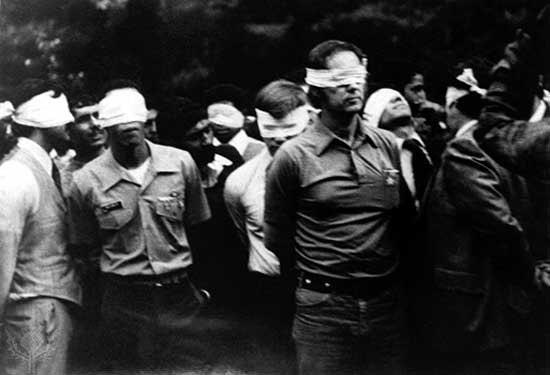
In November of 1979, I was a senior in high school when Iranian students overran the United States embassy.  One of the first acts of the Iranian students was to release the embassy’s African American personnel.  They explained that they recognized that the U.S. Black population was an oppressed national community and as such could not be held responsible for U.S. imperialism in the same way as white citizens of the U.S.  At the time, there was no great outcry about this turn of events.  In fact, discussion of this move, if I remember correctly, was quite muted.  We, my Black friends and I, all teenagers, felt that the students were correct.  Even if they had released the U.S. Africans to make political points, it was still the right move.  In the next several years after I had moved on to college, I continued to meet U.S. Africans who applauded the Iranian release of the Black personnel. 

There was, as there always seems to be, one Black man who chose to stay, wanting to demonstrate his loyalty to his white co-citizens.  For him, his American identity trumped his African identity.  He was the U.S. propaganda answer to the Iranians’ public act of solidarity.  The ideological struggle that ensued has been waged ceaselessly, and unevenly.  The U.S. state and its civil society, especially its media, launched a campaign seemingly designed to convince U.S. Africans that they are Americans, despite their ongoing experience of exclusion and repression in U.S. society.  I once referred to this media practice as the over-determination of African Americans as citizens in the representational practices of U.S. American mainstream film and television.  By over-determination of African Americans as citizens I mean the practice of casting Black actors as police, prosecutors, judges, military personnel, FBI and CIA agents, political office holders – including the U.S. Presidency – and teachers, roles associated with a tacit, and sometimes explicit, acceptance and defense of U.S. legitimacy.  These are characters engaged in the defense of the U.S. system, and the extension of supposed U.S. values.

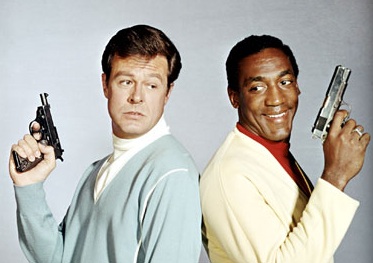
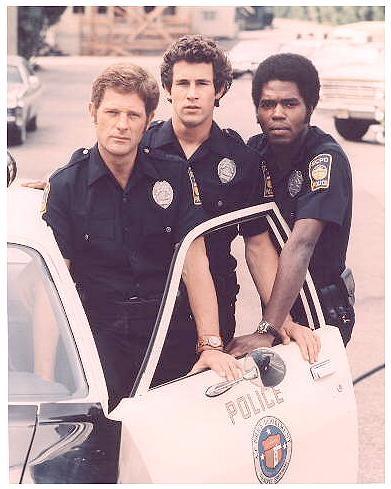
Of course, the emergence of the Loyal Black in U.S. visual media has a long genealogy, predating the height of the Civil Rights and Black Power Movements.  But let me start there.  Already in the mid 1960s, Bill Cosby and Greg Morris were playing spies on television, the former in I Spy and the latter in Mission Impossible, their characters doing their part to win the Cold War for the West.  The characters were distinguished by their technical intelligence, genuine geniuses, traits the Black viewing audiences were prepared to embrace after so many decades of Step-n-Fetch-it buffoonery.  In the early 1970s, The Rookies included George Sanford Brown’s character, a young, first year LAPD officer needing to show himself and his captain that he could be loyal to the force and to law and order, not to the demonstrators in the street.  Not long after, Starsky and Hutch showed up with their overwrought Black captain played by Bernie Hamilton and their own Black pimp informer, Huggy Bear, played by Antonio Fargas.  At a time when U.S. federal, state and local police agencies were engaged in the violent – and illegal according to their own laws – repression of the Black liberation movement, these television series worked to legitimate U.S. authority in African minds. 

While the CIA was busy destabilizing and overthrowing revolutionary and progressive Black governments and organizations in the world, Bill Cosby was being used to make us think that the political plight of Eastern and Southern Europeans was the central contradiction with which we should identify.  While the FBI was infiltrating and assassinating Black Panthers, we were led to believe S.W.A.T. was the last defense against anarchy, and that the Black members of the team were the models we should follow.  So when the Iranian students released the U.S. Africans, shivers went through this country.  U.S. Africans still enjoyed an international reputation for commitment to justice, for righteous struggle, for principled solidarity.  The Iranian action represented a foreign policy victory for the Black Liberation movement despite the political and military repression.  U.S. white power, with the enthusiastic aid of the U.S. Black petty bourgeoisie, could not let this stand, and with the ascension of Ronald Reagan to the Presidency, the re-inscription of the U.S. mythology was well underway.

The Loyal Black character must remain committed to the project of the United States.  When racism emerges in the lives of these characters, it is construed either as an aberration in U.S. society or the problem of individuals who have lacked exposure to non-whites and thus could not develop the requisite tolerance, or individuals of color unwilling to leave the “mistakes of the past” in the past.  These characters overcome obstacles through their own intrinsic abilities, including the moral fortitude to overlook the petty prejudices of unenlightened whites.  There connection to community stops at their families, a common theme of alienation from the Black community at large being a characteristic trope of these narratives.  These characters have made it out of the ghetto or small Southern town (Only hip, white characters can have transformative and healthy relationships in communities of color.).  These characters make white America very comfortable.

The last ten years have seen a proliferation of these characters: the CSI franchise features Black characters in all its versions, criminologists and medical examiners lending credibility to police work for Black viewing communities, as has Law and Order through the 1990s and into the new century.  Dennis Haysbert went from playing a presidential candidate and then the president on 24 to playing a commanding officer in the popular military drama The Unit.  On 24, he was followed by D.B. Woodside who played his brother, his chief of staff and eventually the president also.  L.L. Cool J now plays a naval criminal detective in NCIS: Los Angeles.  The contradictions that exist between the U.S. national African community and U.S. police agencies and other government agencies remain absent from most of these stories.  If they should ever appear, for example an episode about the shooting of an unarmed Black person, more common in life than on television, the story tends to revolve around the justifiability of the officer.  The investigators’ integrity is not to be impugned, and community reaction is represented as unreasonable and too quick to accuse racism.  The police are generally vindicated and the Black community chastised.  When the police are explicitly corrupt, for example in The Shield, their characters are still drawn with complexity and compassion, allowing the audience to sympathize with their difficulties if not approve of their choices.  The Black criminals rarely exhibit such depth.  There can be no sympathy for them.  An independent, Black humanity must be discouraged.  A life apart from white people must be rendered unthinkable.

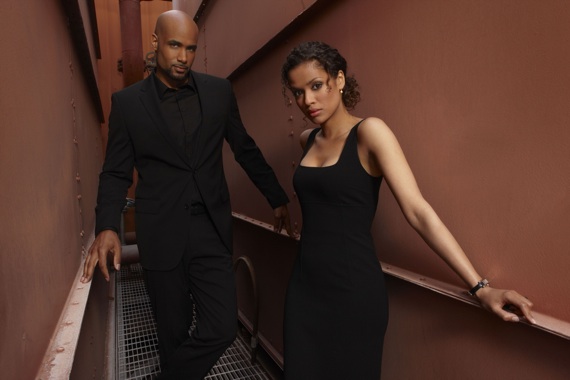
I bring all this up, because there is a new spy drama premiering this fall on NBC in the U.S.  Undercovers features a husband and wife spy team, featuring Boris Kodjoe and Gugu Mba Tha-Raw respectively.  As the U.S. currently wages a global war against so-called terrorism, a global offensive looked upon with widespread skepticism by the majority of African Americans despite the vociferous support and belligerent policies of Barack Obama, we are presented with beautiful spies to remind us for which side we are supposed to cheer.  Young, intelligent, attractive, and hip, Kodjoe and Mba Tha-Raw are the latest players deployed in the struggle for the hearts and minds of U.S. Africans, especially youth.  U.S. media bombard African youth with these images of successful, economically solvent Blacks in the service of U.S. policy, domestic and international.  The media images reinforce the message put forth by Black elected officials, pop stars, celebrities and athletes: the U.S. is uniquely situated for individual Black achievement.

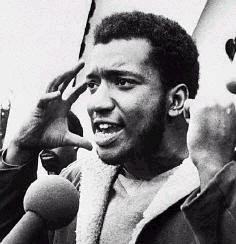
Of course, the working class girl living in the projects is not the real target.  It’s that young woman who earns decent grades and has been identified as one who can make it out.  At all costs, she must be convinced to use her natural talents and learned skills in the service of the empire, not in the service of her community, the place she needs to escape.  She too can be a spy for the U.S., or a cop, or a teacher who will insist her students recite the pledge of allegiance to the flag.  Why wouldn’t she when the only heroes she has seen and for whom she has cried work to save America from the people who hate freedom, terrorists and gang bangers?  Ain’t nobody making TV movies about Fred Hampton, or about how Assata got down to Cuba.  And when Spike tried to tell Malcolm’s story, the mainstream quickly reinvented Malcolm as a militant civil rights activist, not the Black Nationalist who showed us the way to freedom.  That’s the power of money and access.  That’s why this ideological battle has been waged unevenly.  Black revolutionary forces don’t have the resources of the mainstream, and those Blacks who do have resources, Oprah Winfrey for example, are committed to the empire. Oprah is on record.  She thinks the U.S. is the greatest country in the world ever.  She has learned to love America.  If it wasn’t for conditions of our lives on the ground, I suppose more of us might learn to love America too.  And if another U.S. embassy is captured, will the Black personnel be released in a show of solidarity?  Now that President Obama, General Colin Powell, Condoleeza Rice, and the myriad pro U.S. Black characters exported with Hollywood product have become our international face, that prospect may be less likely.  That would be a foreign policy victory for the Black petty bourgeoisie and U.S. Empire.

Zombie # 1 and # 2

Zombie # 1

When did he steal your soul, zombie?

What wicked sorcerer drained you?

Poured your soul out, a libation

An offering, slow, sweet and black

For the dead who eat the dead and

Never grow full, some dark rum for

The bloodless devils that live in

The emptiness left inside you?

Zombie, look at you. Can you see

Your reflection in a pool of rain

Water or a mirror when your

Stolen soul is not your own soul?

Does a dead man watch from the glass?

Can he see you fade into ash?

What rider drives your head zombie

And makes you think you drive alone?

Zombie # 2

New boots cross the waxed floor.

He looks down and sees his face

Clean shaven, brown and bending

Beneath the rubber soles.

He pushes the corners of his lips

Down to hide the joy that pricks

His skin. Delighted to be under

The eyes of grateful civilians,

He can feel his pants fabric stiffen

At the thought of rapid discharges

And the recruiter’s promise of

All the foreign pussy he can fuck.

Future White: The Imaginary of a White-only World

(The following essay is a re-working of a conference paper from the March 2010 National Council for Black Sudies Conference in New Orleans.)

Nearly halfway through the 1972 film Cabaret, a blonde, Hitler Youth boy stands up and begins to sing a rousing, Nazi hymn.  Soon, he is joined by the fervent adult café patrons singing with passion the hymn’s refrain: “Tomorrow belongs to me.”  The whiteness of the future is a taken-for-granted condition, and it is taken so because it is the taken-for-granted condition of the present moment.  That is, the dominant representation of human beings and human society remains white representation despite the majority status of people of color.  But it is not a question of numbers but of power.

What we dare to imagine is also a question of power.  If people of color cannot be disappeared, then they are imagined in numbers that do not challenge white majority or power.  The difference is between the extreme and the moderate imaginary of a white future.  What matters in both positions is that the racial hegemony be maintained. This is an ideological reproduction of whiteness, the habitus of white supremacy, the “… structured structures predisposed to function as structuring structures, that is, as principles which generate and organize practices and representations that can be objectively adapted to their outcomes without presupposing a conscious aiming at ends or an express mastery of the operations necessary in order to attain them” (Bourdieu 53). The habitus of white supremacy thus remains masked, including the mask of science fiction.  The representations of the future follow a genealogy and logic of representation consistent with the grand narrative of Western Civilization.  Canonical narratives, and also those post-structural narratives, center Western and “white” history as the essential history of human progress.

Why shouldn’t white writers and producers imagine a future world for imagined white audiences?  This representation of whiteness, that is, its ubiquity its typicality, and its mobility, do not necessarily emerge as a consciously or willfully racist imaginary.  Rather, the white supremacist imaginary I wish to trouble is the conviction submerged in the expectation that whiteness is the “natural” condition of the world and the assumption that what is good for white Europe, the white Americas, white Australasia, white populations anywhere in the world, is best and right for the world.  Moreover, those people of color found worthy of the future, if any, are those who best approximate what may be called white-ways-of-being-in-the-world, or being-for-the-whiteness-of-the-world, also called Westernization, which Dr. Cress-Welsing reminds us, along with West and Western, is a code term for whitening and white (23).

The growth of print capitalism and the subsequent journalism profession and book industry, along with the professionalization and standardization of education, made it possible for the various European powers to “naturalize” their power in the world through the dissemination of white narratives of superiority and destiny.  Fanon refers to this process as the creation of a Manichean world (41).  The development of audio and visual mass media, specifically film and later television, extended the reach of these narratives.

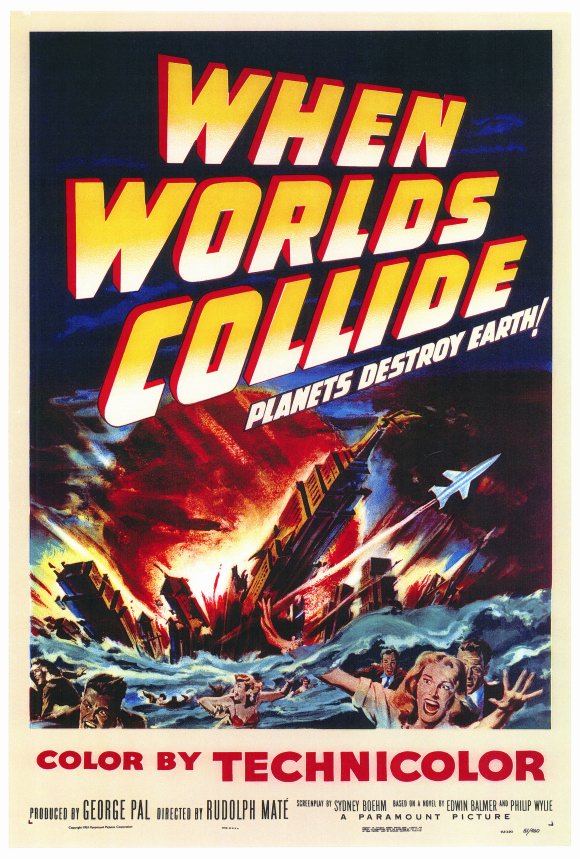
The extreme and moderating position correspond to a conservative or right wing and a liberal-progressive or left wing futurist imaginary of white supremacy wish-fantasy. In science fiction, from among many possible examples, I will look primarily at the 1951 film When Worlds Collide as the extreme position and The Star Trek franchise as the moderate position.  There are anomalies in the mainstream that dare imagine a future that is not exclusively or near exclusively white, namely the recent film adaptations, The Time Machine and Children of Men.

White Flight: When Worlds Collide

Producer George Pal, screenwriter Sidney Boehm and director Rudolph Mate’ adapted the 1951 film When Worlds Collide from the 1932 Wylie and Balmer novel of the same name.  The fundamental story is as follows:  a dying star is on a collision course with Earth.  A small group of scientists recognizes the impending doom, reports it to the world governments, and proposes building a fleet of new “Noah’s Arks” to fly to what seems to be a hospitable planet.  When they are rebuffed, several industrialists, and especially the super wealthy Sydney Stanton, agree to fund the building of a rocket ship to carry 40 people to the new planet, all in about 8 months.  In the novel, white, educated, Christian professionals comprise the remnant to be spared destruction.  The only person of color to make it onto the ship is Kyto, the Japanese servant of one of the characters.  He is written out of the film.

An ethos of eugenics pervades the novel and film.  Dave Ransdell, the pilot who first delivers the astronomical report to the concerned scientist, is a paragon of Anglo-Saxon transnational masculinity.  He is a South African citizen born and educated in Pretoria whose father was an Englishman ranching in Montana.  His mother was a girl from Montana whom the Englishman married and whisked away to the Transvaal.  Dave is tall, blond, handsome, witty, and flirtatious.  Women are drawn to him.  Other men like him.  Dave Ransdell is completely unencumbered by the presence of people of color.  They simply do not exist for him, not even in the supper club where the band has no musicians of color nor visible wait staff of color.

The film projects an idyllic future on the new planet, most difference and the possibilities for contradiction having been erased by the remnant’s escape.  The survivors are homogenous, heterosexual, paired like Noah’s animals, two of each useful kind.  The film re-enacts the Age of Exploration, this time without the complication of a racialized indigenous people.  However, the novel’s sequel does introduce an indigenous people on the new planet, and very quickly identifies them as Caucasian.  In both texts, it’s like a do-over for Columbus.

The release of the film coincided with the era of white flight from U.S. American cities.  When the star hits Earth, there are scenes of the Atlantic Ocean flooding the streets of New York as the undesirable external and internal immigrants have flooded them.  Now they are washed away in the deluge, as is the population of this overwhelmingly colored planet.  The fictional, cinematic, “real” flight of the characters flows neatly into the historical, metaphorical white flight out of the cities.

The Prime Directive

Since the eradication of people of color is unlikely, and indeed impractical for capitalism, the practical habitus of white supremacy is white control, the maintenance of white hegemony. This practice functions fully in another Age of Exploration do-over, Star Trek, the creation of Gene Roddenberry, a declared liberal humanist (Bernardi 34).

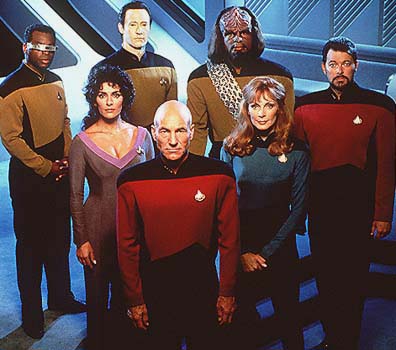
The mid 1960s television show Star Trek has developed into what Daniel Bernardi calls a mega-text, “a relatively coherent and seemingly unending enterprise of televisual, filmic, auditory, and written text” (7). The ongoing popularity of Star Trek encouraged the creators to make several feature length films and a new television version by the late 1980s, Star Trek: The Next Generation.  The popularity of this version spawned two more spin-offs, Star Trek: Deep Space Nine and Star Trek: Voyager.  The future imagined in Star Trek realizes most of the socially progressive, utopian even, ideals: peace among humans, no poverty, free and universal healthcare and education, democratic structures, no genuine distinction between classes.  The Earth has membership in the United Federation of Planets, a league of planets which maintain political independence and freely associate for purposes of trade, cultural and scientific exchange and mutual defense by Starfleet, the Federation’s military institution and the jewel of the Federation, and the principal site of Star Trek’s narratives. 

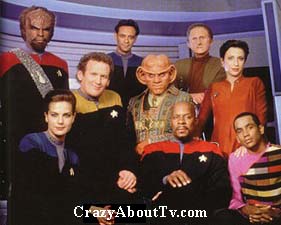
One thing remains clear in the Star Trek mega-text, and that is what I am calling the prime directive; white characters must be in charge, even in this egalitarian future.  White supremacy is softened but not challenged.  Star Trek: Deep Space Nine, featuring an African American captain, has curiously enough taken on a type of heretical status.  This version of the text does routinely raise troubling questions about the utopian future of the mega-text, for example, the notion that Starfleet officers may achieve their ends by subterfuge, or that there would arise dissidents within the Federation.  But really, in this essay, I am less concerned with these disturbances in the Star Trek flow as I am in how the universe is imagined.  The universe of Star Trek is populated by whiteness.

Through the course of the original series, the crew of the Starship Enterprise finds a planet that looks like and has the technology of Twentieth Century Earth and a society in which the Roman Empire never fell.  They visit another planet in which one of their own officers, disregarding the Starfleet prime directive of non-interference in the politics and culture of new planets and people, has set up a new Nazi state.  They visit a planet ruled by people approximating classical Greece.  Where ever they go, they find a universe as white as the television world in which the actors, writers, directors and producers worked.  The vision of the universe confirms the ideology: whiteness, the phenotype associated with whiteness, is the norm.  Even those aliens who are green or blue or spotted humanoids retain white phenotype or European features.

The crew of Star Trek: the Next Generation visits exactly one planet in the universe populated by Black people, Ligon II, where the culture seems modeled on the Sahelian Kingdoms of West Africa circa the 12th and 13th Centuries.  Perhaps they also live on Ligon I, a planet never visited.  This aspect of the many alien “races” with which Starfleet comes in contact remains the case in Deep Space Nine and Voyager.  For example, one of the narrative lines in Deep Space Nine is that of Odo, a shape shifter or changeling, non-humanoid.  Odo’s people are essentially sentient, conscious liquid beings who simultaneously retain individual self-consciousness and a collective consciousness when they are in physical communion with at least one other changeling, a collective they call the Great Link.  Able to approximate any physical form, when they take humanoid shape, they always approximate whiteness.  They assume the humanoid form taken as normative in the universe of Star Trek.

The crews of all the various versions of the series are always multi-ethnic, multi-racial, multi-(humanoid) species.  The writers have the characters expressly talk about the Earth’s primitive past when racism almost destroyed humanity (Bernardi 27).  So whereas the makers of Star Trek saw and see themselves as engaged in a liberal project to de-emphasize race and promote tolerance, they reproduce the ideology of white supremacy despite their best intentions.  White circuits of power remain at play in the entertainment industry.  White producers hire white writers and white actors.  How else could the universe be visualized then?  Star Trek offers a picture of the future, an expectation of what many contemporary humans hope to find “out there,” and whom others hope one day will visit.  Much of what is hoped for is more of the same, the ubiquity of whiteness.

Black to the Future?

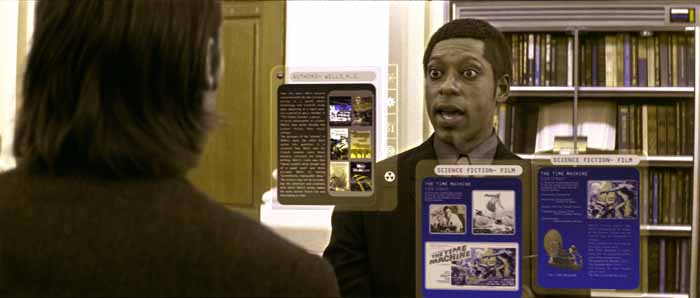
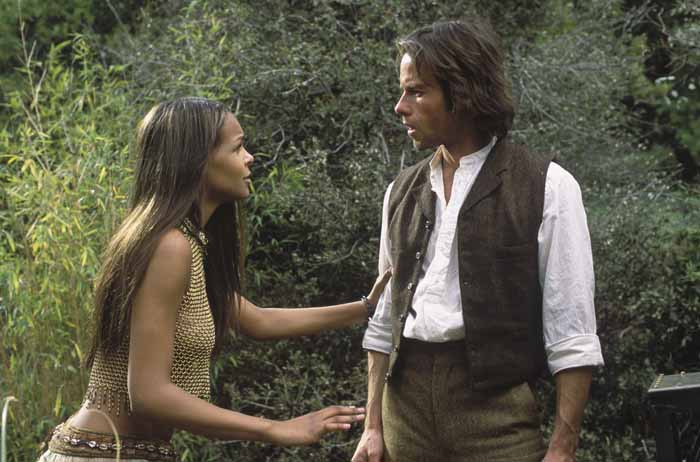
The 2002 version of socialist, feminist, futurist and racist writer H. G. Wells’ novel The Time Machine actually has our scientist-hero finding a future world in which the remaining humans have been de-industrialized and live in relative peace, the danger coming from the no-longer-human and white from lack of sun Morlocks who live beneath the Earth.  The typical human in this future is a person of color.  Our hero makes himself at home in this world, having thrown off any attachment he may have had to the white past with the loss of the fiancée that provoked his attempt to manipulate time.  The story maintains the habitus of white supremacy in that it is the story of one white man’s journey.  But by the end, our hero willingly gives up his whiteness as he settles into a life among his fellow humans, not as leader but as a member of the community.  The repository of knowledge, knowledge that outstrips the scientist’s own, is embodied in the holographic image of a Black man, played by Orlando Jones, a futuristic griot projected by what remains of 21st century technology.

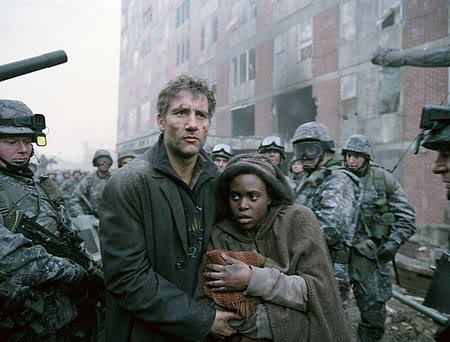
The 2006 dystopian film Children of Men presents a vision of the future, a believable near future, in which environmental degradation and nuclear catastrophe have resulted in a world characterized by military totalitarianism, extremes of poverty and wealth, and most notably, generalized female sterility.  What is striking about this film is that it revolves around the only woman to become pregnant, a Black woman, an unambiguously, African descended Black woman.  This move was absolutely startling, a re-inscription of the Black Madonna as Black.  It offers a genuine break with racial representation traditions, dramatized more emphatically by the death of all the principal white characters.  That they would cast the character as a Black woman and get the film made seemed a genuine moment of rupture.  

Conclusion

If the functional habitus of white supremacy is white control, a more generalized habitus of white supremacy wish-fantasy is the erasure of the non-white.  This habitus is demonstrated in the genocidal practices of European settlement of the Americas generally.  Less well known are the institution of Sundown towns, U.S. towns and cities with written and unwritten laws that Blacks and other people of color had to be out of the town before the sun had gone down.  There was also the practice of running Black families out of towns in order to make them white towns.  To this we may add the sterilization practices of the Federal and various State governments, the extra-legal executions we call lynching, which included the ritual castration of the victim, thereby symbolically destroying the progeny of a dying or dead man, and indeed the redundant eradication of the individual, combining hanging, castration and immolation.  Today, the U.S. State and civil society resort to lynching-by-police-officer.

An imagined white future reflects an imagined white present.  The policies designed to secure the white present and future have only threatened them both.  They have resulted in de-funded public infrastructure -failing schools, closing hospitals, growing prison industrial complex- and the over development of outlying areas that further entrenches reliance on fossil fuels and encroaches on what is left of the natural environment.  These policies, along with the unofficial policy of Black removal euphemistically called gentrification and the official embrace of three strikes laws and a now ten-year-old reclassification of many Black people as Biracial, often self-selected, make their stand in the ideological space created by the cultural.  Greater Harlem is no longer majority Black.  Los Angeles continues to hemorrhage African Americans into the outlying counties of Southern California, and New Orleans still refuses to allow its levee Diaspora to return.  At a moment of delusional post racial fantasy, Black folks are being legislated, redlined and ideologized out of memory and out of the future.

Race War

It seems that it’s only a race war when white people die.  A week ago, avowed white supremacist Eugene Terreblanche died, killed in his bed by two African workers he allegedly mistreated.  The workers didn’t try to escape. They called the police and waited.  The killing of Terreblanche, a man who changed his name to evoke white superiority, occurred in the increasingly tense political atmosphere of South Africa in which African working class and peasant citizens grow impatient with a New South Africa led by the ANC that replicates the social relations of the old South Africa.  Like Zimbabwe across the border, white settlers are growing unsettled by increasingly belligerent relations with the Black dispossessed peasants and workers.  White lives under fire make it a race war in the eyes of mainstream commentary.  Even though Black people die exponentially every month, the ordinary victims of violence and neglect, we are not seen as casualties of race war.  But race war is exactly what has been waged by the North in the Modern Era.  Indeed, race war from Europe marks the fundamental character of the Modern Era.

Woodcut of European atrocities against First Nations

The deaths of dark skinned people are taken for granted as one of the unfortunate vicissitudes of modern life and backwardness.  The relationship between industrial society’s living standards and the degradation of the world’s majority populations hides beneath chatter about good governance and development.  The primary beneficiaries of these uneven relationships remain blind to their own complicity in plunder and the frustration of genuine democracy and social transformation.  That people in Africa, Asia, Caribbean and Latin America, and the Pacific routinely die to maintain the flow of wealth from southern resources to northern companies, China and India notwithstanding, is an afterthought if it is a thought at all.  That African people, First Nations people and other people of color routinely die to maintain the flow of wealth from exploited communities in North America to primarily white communities in North America cannot even be mentioned in the mainstream media.  People of color are supposed to die.

But white people’s lives are precious.  The U.S. media’s obsession with missing, young white girls has become a running joke on primetime television.  The race of the victim of murder weighing heavily in capital murder cases has been admitted by the U.S. Supreme Court, cases with white victims earning capital categorization more consistently.  So when the media begin to express fears of race war breaking out, what they really express is fear of white people dying in large numbers at the hands of people who are not other whites.  That is the fear of the uprising on the plantation, the enslaved slitting the throats of the slaveholders as they lie in their beds; that is the great sense of betrayal for the gun runner who sells rifles to the Indians.  That is the fear of the oppressing minority ruling the majority with iron boot to keep at heel the wave of resistance that could overwhelm the minority if the majority ever could show a unified force around freeing the land rather than only dismantling a system of exclusion and segregation.  It is also the resentment that has flavored U.S. American politics since Nixon appealed to the Silent Majority who believed in law and order.  Law and order always carries a racialized taint of keeping the Blacks and Indians in check. So when a cop shoots a Black man, that is not race war, and when several cops shoot a young man after his bachelor party, some of the cops also Black, that is not race war.

Terreblanche was a white supremacist without the apology.  He thought that Black people were worthwhile only insofar as they served the purposes of white people.  The man was vile, an open fascist, and the more naked face of racism.  His people may have loved him, some openly and others secretly, but he was a spokesman and worker not simply for hate and inequality, but for genocide and slavery.  Terreblanche knew that race war was already the condition of relations in Southern Africa.  He fomented race war, war against people of color, especially Black people.  He understood the importance of Black people not recognizing the real character of the social and political relations in South Africa.  He may have railed against an ANC led government, against the “affront” of black power, but he knew that power relations in South Africa had only cosmetically changed, very much like the United States.  The fact of white privilege emboldened him to continue to treat his workers poorly.  What accountability did he have to fear?  He had already served prison time, making him a political martyr for the cause of white supremacy.  His behavior betrays the impunity under which he felt he operated.

So when Western pundits and “responsible” Africans condemn ANC youth minister Julius Malema as stoking racial tensions to the point of inciting race war through singing the song “Kill the Boer,” it would do them well to remember that race in this world is predictor of early death and frequent death.  Race war is already the condition of relations.  If the government of South Africa really wants to prevent more bloodshed, if the proponents of non-violent resolutions to colonial problems –some of whom were prepared to bomb Zimbabwe in order to “deal forcefully” with Mugabe, despite their clerical habits- want to prevent the outbreak of a full scale civil war, they should consider banning Black poverty rather than banning liberation songs from an earlier era of struggle.  Then again, those old songs do remind folks of what is really at stake: the struggle is for the land, and whites still own 87 percent of it.  They still control the economy and the military.  What kind of independence is that?

Eugene Terreblanche died for his sins.  Who else dies is an open question, but an anti-apartheid struggle or a Civil Rights movement does not make a liberation struggle.  That struggle remains unfinished. Free Azania, Free the land!

Read: panafricannews.blogspot.com; uhurunews.com; blackagendareport.com; voxunion.com; blackpowermedia.com

Forward ever, backward never!

Two Thousand Seasons: Memory and Resistance

(The following essay was first published in the Ethiop’s Ear vol. 1, winter/spring 2000)

“White civilization and European culture have forced an existential deviation on the Negro [sic].”


 So writes Frantz Fanon near the end of his introduction to his work Black Skins, White Masks. Ayi Kwei Armah attempts to correct that deviation Fanon identifies. He tries to realign the Black body with the Black soul in his mytho-epic work two thousand seasons, an effort to no less than re-inscribe the movement of Afrikan peoples through their history in the image of its makers, the Afrikans. The novel endeavors to extricate Afrikan meaningfulness and purposefulness from the colonial/neo-colonial paradigm of master and slave In Afrika and the Afrikan Americas relative to the European and Arab economic, political, and cultural self-interests. The novel is nothing less than an attempt to place the Afrikans at the nexus of their own ontology. Armah has not composed a doctrinal fiction servile to Fanon’s analysis of the colonial situation, for the differences between the brothers are mani­fest in their writings. Where Fanon expressly wants to liberate Afrikans from their blackness, Armah wishes to liberate Afrikans through their blackness, or perhaps more correctly, through their Afrikaness. (What a difference a preposition and some geography make.) For Fanon, Blacks are black because Whites have constructed them, in definitional opposition to the trope of whiteness. The Blacks become the essential other; more other than even woman is from man. When the Afrikans choose to simply be men and women, when they willfully remove themselves from the non-equation, black does not equal white, then they will be free. Then their mental world will be their own again.

Armah also rejects the non-equation, black does not equal white; however, Armah insists that the liberation of the Blacks burns in the willful decision to explore the difference, to expound the difference and walk accordingly. Fanon challenged the doctrine of the Rightness of the civilizing project colo­nialism and its antecedent proselytism purport to be; Armah takes up Fanon’s struggle to remove the pernicious constructs that make it easy to believe that the Afrikans ultimately benefitted from centuries of slavery and colonial 

oppression. The idea that the invaders are after all our friends, Armah hurls from the Afrikan universe of meaning, like a god expelling an offending demon. (I am aware that my prose is sprinkled with terms from the semantic field of religion. These matters do have a quasi- spiri­tual quality to them, as many in the social sciences, the arts and humani­ties, academia, have made their living off the routine apotheosis of that elegant construct, the West). Armah and Fanon looked to that day when an Afrikan in New Orleans, or Lagos, or Kingston, or Salvador, Bahia will no longer reverently thank Europeans nor Arabs for bringing “true religion” and modernity to the Afrikan World.  Two thousand seasons directly assaults the hierarchical oppositions white/black, civilized/savage, believer/heathen, master/servant, savior/bane. 

Armah postulates, re-postulates, a complementary duality as the pivot upon which Afrikanity spirals in ever renewing meaning. Armah names the duality Reciprocity, and makes it the ethical center of the Afrikans’ moral universe. Reciprocity is the sign par excellence of social Afrikanity, “our way, the way,” he continually characterizes it.

“Reciprocity. Not merely taking, not merely offering. Giving, but only to those from whom we receive in equal measure. Receiving, but only from those to whom we give in reciprocal measure. How easy, how just, the way.”

There in is Armah’s objective, the demonstration through the medium of fic­tion of that philosophical principal central to his idea of social intercourse in the ideal Afrikan world, always with the understanding that ultimately, the Afrikans themselves are responsible for their past and present predicament, as well as its resolution. Reciprocity in all things. Armah is particularly self critical, self interpreted as the communal self. It is a significant strength that he insists continually on self examination. Yet how easily, how utterly you have forgotten it. You have forgotten that justice is not ease.” The novel is written as a memoir. Whose memoir? The memoir of a people, a race? The narrator, the utterer of the memoir remains nameless from beginning to end, identifying only as “we”. The temporal scope of the narrative ranges nearly a thousand years of history. Yet the narrator, the rememberer, writes as an active participant-witness in the events of the novel, the plot driven by a series of migrations. Where are we migrating to, we who know that we begin from one source? From what depths and how many movements across the vast continent of our soul? How has migration shaped our experi­ence of meaning in the world, and meaning between humans? The remem­berer remembers the sweep of seasons across a past that exists contempo­raneously with the present and the future if it exists at all. So certainly “we” are an actor in the unfolding history Armah recalls.

Armah is writing a philosophical discourse clothed as narrative and com­mentary on the narrative which turns in upon itself as a memory of itself. Armah, a participant in the ubiquitous “we” of the memoir rejects any pre­tense to detachment or distancing, thereby rejecting any distinction between the writer and the text. The text, this text which recalls itself as memory, is not other than the writer, is not external to the writer. Rather, the text is the expression of our collective memory, the memory of our bodies, and the Body of our memory. It is resistance to meaning as con­structed under colonial and neo-colonial conditions. It resists meaning as constructed under conditions of white supremacy, of northern supremacy, of religious supremacy. As memory, the text embodies the writer’s experience of the existential deviation which he, through the heroic act of remembering – the heroic act he invites us to accomplish- seeks to correct.

Memory is the writer’s resistance, and is the memory of the body, its uncom­promising black and brown hues, the very resistance Fanon tells us exposes, and thereby destroys, the delusionary Manicheanism of the racial suprema­cists. Through the will to memory, and violent resistance, the good/bad, white/black, sacred/profane oppositions enunciated by the agents of civiliza­tion and religion fall away. The supremacists see the resistance as demonstra­tions of the need for the civilizing project. But for the Afrikan, it is death giving life. Through violent resistance we see that the colonizers and supremacists bleed as profusely as we ourselves do. If the bodies of the once godlike strangers are susceptible to spearheads and bullets, then why shouldn’t their metaphysics also be susceptible? Their

Ideological authority must be overturned as well as their political authority. How can the Afrikans free their bodies, free their land, and free the culture if they cannot free the textuality of the black body from the imposed and imposing discourse of white domination? Without memory, we are obligated to repeat the sins of our fathers and of our conquerors together. Without memory, we will not revision ourselves:

“We are not Europeans, we are not Christians that we should invent fables a child would laugh at and harden our eyes to preach them daylight and deep night as truth…we are not Arabs, we are not Muslims to fabricate a desert god chanting madness in the wilderness, and call our creature creator. That is not our way”

We embark on this migration in time with Armah to re-locate Afrikans at the center of their own universe of signification, to re-invent and re-inscribe the institutions which had once produced Afrikan meaningfulness. As the matrix of this meaningfulness, Armah presents reciprocity, and calls upon Afrikans to remember reciprocity as they remember their fear, awe, or indif­ference toward the Black and White agents of the destruction of reciprocity.

Paradoxically, Armah conveys his project of remembering, his re-inscription of the text as the memory of itself, through the ubiquitous meaning producing institution, language, specifically the English lan­guage. The question of language is a critical issue in post-colonial Afrika, as the nation-states, perhaps already obsolete, strive to create national identities out of diverse ethnicities. In most of the non-Arabic speaking countries, the question arises, which language? Taking Nigeria as an example, should Hausa become the language of commerce and education, or Ibo, or Yoruba? And what of the Nemai, most of whom speak European languages or Arabic, must these Afrikans learn multiple languages in order to be active players in Afrika’s intellectual life? These are important questions, but they are not to be answered here. The immediate concern is how Armah resolves the paradox in his attempt to re-inscribe the existentially deviated Afrikan through the agency of the colonizer’s lan­guage. He turns the sign upside down and inside out.

Armah’s subversion of the sign is most evident in his uses of the terms “white” and “black.” White and black ordinarily signify an oppositional duality in which white is emblematic of all that is good and pure and life affirming, whereas black is all that which is not. Indeed black equals not-ness, the supreme sign of lack. Now consider Armah’s usage:

“What when the tumult and the rush are yet too strong for the voice to prevail uttering heard sounds of origins, transmitting seen visions of purposes? What when all our eyes are raped by destruction’s furious whiteness? Easy then the falling slide, soft the temptation to let despair absorb even the remnant voice. Easy for unheeded seers, unheard listeners, easy for interrupted utterers to clasp the immediate destiny, yield and be pressed to serve victorious barren­ness. Easy the call to whiteness, easy the welcome unto death.”

Throughout the novel, whiteness signifies death, barrenness, and destruction. It is the desert which swallows the life giving spring waters flowing from a seemingly inexhaustible headwater, running deep and black. Whiteness is to be avoided. To wash black souls white as snow, as the Christian hymn assures the believer, is tantamount to psychic murder-suicide in Armah’s sig­nification. Indeed, knowledge of Black positivity is the essential knowledge the Afrikan emptied of authentic soul lacks. The true villains of the novel are those Afrikans whose souls are not their own, whose souls are white­washed, the askaris or soldiers who serve the invaders and their gods.

Let us return to Fanon with whom this reading began. To speak a language is to take on a world, a culture,” advises Fanon. Certainly the extent to which the “savage” masters the language of the colonizer is the extent to which he or she “gains” civilization. The so called savages are well aware of this and make conscious efforts to acquire or not acquire such mastery, as if language were a thing to that could be mastered, without exercising mastery over the speaker. However, facility in the language of commerce and education “opens doors,” as people say. Armah knows this, having sufficiently mastered English to earn degrees from Harvard and Columbia. Armah is a man in conflict with the language he has mastered, for in his mastery, in our mastery, he and we are mastered. In our control of the dominator’s language, we take on the dominator’s world and culture. We become participants in European civilization. He and we have indeed opened the doors to privilege in our societies through control of the dominant language, but Armah questions the wisdom of entering the great white hall.

Armah stands us at the threshold of European civilization with two thou­sand seasons. Using that civilization’s most enduring tool, he summons those like himself who dare heed him to come out of the cemeteries of our psyches, to come out of the mosques and churches, to remember our past. We re-inscribe the meaning of Afrikanity, the way, when we write our text as memory, the memory of our beginnings, the memory of our migrations, the memory of our bodies.

Works Cited:

Armah, Ayi Kwei. Two Thousand Seasons. Nairobi: East African Publishing House, 1977.

Fanon, Frantz. Black Skin, White Mask. New York: Grove Press, 1967.

                               The Wretched of the Earth. New York: Grove Press, 1967.


Black Is Back and Overdue

(If photos below are not visible, click the x to view.)

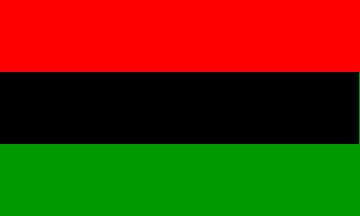
Over the weekend of January 23rd and 24th in St. Petersburg, Florida, a new coalition of progressive Black organizations and activists convened for an agenda setting and organization structuring conference, the Black Is Back Coalition for Social Justice, Peace and Reparations National Conference.  The Black Is Back Coalition describes itself as an organization of organizations, “comprised of otherwise independent groups and institutions that fit within the generally anti-imperialist, self-determinist tendency of the African community.”[i] 

This is a welcome development in the political life of the African national community in the United States.  For thirty years now, U.S. Africans have been hamstrung by our overwhelming allegiance to the national Democratic Party and its state and local branches.  Yet too often, those bemoaning rock-solid Black support for Democratic candidates have offered either a turn to the Republican Party, a solution rightly resisted and ignored, or a support of alternate parties like the Green Party, that are still perceived as primarily white institutions, rightly or wrongly, despite the recent presidential ticket of Cynthia McKinney and Rosa Clemente, both African women and the latter also Latina.  An organized, leftist, nationalist, internationalist, grassroots political presence has been relegated to the hard and obscure struggle of genuine community organizing, often around local and very specific issues rather than some sort of national program of action.  The Black Is Back Coalition can fill the empty space in Black politics created by the cooptation of Civil Rights Movement politics into the Democratic Party and the military defeat of the revolutionary struggle of the late 60s and the 70s.

At what point does optimism become fatal?  Recent Pew poll[i] results report a significant increase in the percentage U.S. Africans who feel like they are better off now than they were 5 and 9 years ago despite the hard facts on the ground of higher unemployment and a wider wealth gap than in either 2004/2005 and 2000/2001.  Black folks in the U.S. remain over-represented in every negative indicator of living standards in the United States.  But still too many Black folks are living off the heady fumes of having voted for President Obama and feeling that they have representation at the pinnacle of power in the United States.  The actual exercise of power either ignores the Black condition or acts hostilely toward Black people, especially the majority Black working poor.  That includes the way President Obama has been wielding power, like a corporatist, a militarist, and an imperialist.  Black Democratic Party activists have been effectively silenced by the White House and the Democratic Congressional leadership.  The Black is Back Coalition provides a principled opposition to the anti-democratic, class-war-from-above politics practiced by the bipartisan elites in the United States without the restraints embedment in the Democratic Party requires.

One full year into President Obama’s administration, several liberal and left-progressive organizations and activists have harshly assessed the President’s performance. On progressive issues like health care and opposition to the war, the president and Democratic leadership performed woefully, exploiting none of the social energy created by the 2008 election, and thus ceding the ground to right wing forces that were able to construct the health care discourse around an intrusive, bullying government, casting health insurance reform as a mythical socialist takeover.  So I find it interesting that there has been a relative media silence around the Black Is Back Coalition, including and perhaps especially some of the left and alternative media. 

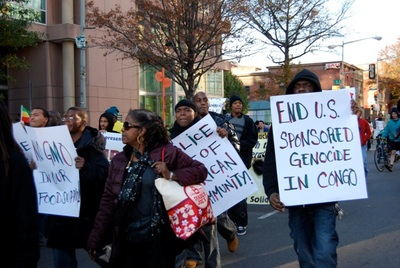
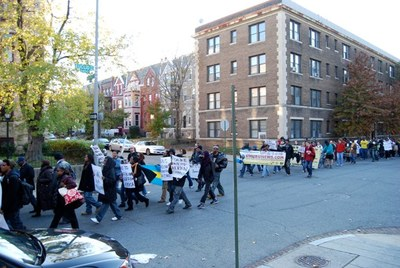
The Black Is Back Coalition held an anti-war rally and a march in Washington, D.C., November 7, 2009.  I could find very little to no announcements about the event in local progressive media, including the local Pacifica network affiliate, KPFK.  C-Span didn’t cover the rally, or the march, its weekend being taken up with the Senate health insurance debate and vote.  The Coalition website posts reports from relatively few examples of the coverage, including two from a participant in the rally and coalition, Alex Morley from Blackfood.org out of the Bahamas.  Besides, Blackfood.org, Agence France-Presse, D.C. Indymedia, NY Indymedia, Free Speech Radio, One People Project, the Los Angeles Sentinel and the Afro American published or broadcast reports on the rally.  In the great mediascape of late modernity, that is precious little coverage.  There is certainly more, especially if one is familiar with African revolutionary cyberspace, but that is still not a thoroughly generalized audience. 

The Los Angeles Sentinel’s coverage is at least somewhat reassuring.  Speakers at the rally roundly criticized Obama for his policies and their execution.  He was taken to task for expanding the war in Afghanistan, maintaining troops in Iraq while calling it a pull out, keeping the Guantanamo Bay prison open, continuing the extraordinary rendition and torture practices instituted by the Bush administration, and his complete snub of any specific African issues, both domestically and internationally.  The refusal alone to attend the World Anti-Racism Conference in Geneva, the follow up to the Durban Conference of 2001 snubbed by the Bush administration, merits deep reproach.  Nonetheless, Black press like the L.A. Sentinel have been nearly exclusively approving in its coverage of the president, going so far as to characterize the severely compromised, insurance industry friendly Senate health reform bill as a victory.  Uncritical reportage of the administration under serves the readership of these papers, and Africans cannot afford to be further underserved or mislead by anyone. 

Since the November march and rally, the Black Is Back Coalition participated in a peace demonstration in Washington on December 18, again with little notice.  The silence around an independent, progressive Black coalition of organizations may arise from the discomfort many on the white left feel with Black Power movement politics, with a politics of Black independence that can accept solidarity but not “allies” who dictate terms.  The members of the Coalition come from the tradition of struggle represented by Malcolm X, the Black Panther Party, and Dr. King in the years after his Nobel Peace Prize.  These are Fannie Lou Hamer’s politics.  The member organizations come from a wide range of progressive Black politics including the African Socialist Internationalists of the Uhuru Movement, the Malcolm X Center for Self Determination, members of the Green Party, a North Carolina NAACP chapter president, Cynthia McKinney and Dignity, Glen Ford of blackagendareport.com, and at least one elected official, New York’s city councilman Charles Barron, among many other groups and individuals.  Such a self determined, anti-imperialist, grassroots U.S. African liberation movement should be supported by left forces in the United States rather than treated with suspicion or as irrelevant. 

The conference held over the weekend of the 23rd and 24th began the process of constructing programmatic actions to create solutions to the modes of attack on the national and international African community, fundamental to creating justice and peace in the world.  The Coalition resolved to oppose U.S. imperialist actions abroad, challenging Obama to end the wars in Afghanistan, Pakistan and Iraq.  The Coalition opposes AfriCom, the U.S. military’s African Command, now headquartered in Germany but looking for a host in Africa, a prospect so unpopular in Africa that even those friendly governments like Liberia’s have not been able to reach an agreement without a political price to pay at home.  The Coalition has resolved to move on the issue of mass incarceration of U.S. Africans, a most stark contradiction of U.S. so-called democratic society.  The Black Is Back Coalition also recognizes the dynamic relationships of state power at work in the interplay of this mass incarceration, increasing at the fastest rate among U.S. African women, the death penalty, and the virtual disappearing of U.S. African political prisoners and prisoners of war.  The Coalition has further resolved to strengthen operational ties regionally with Western Hemisphere African communities outside of the Unites States, evidenced by participation from Canadian activists and Bahamian activists at the November march and rally, and the presence and participation of Alex Morley of the Bahamas also at the January 23rd and 24th conference.  The Coalition resolved to support the Global South in the fight for climate justice, and in its name, makes reparations a critical component of the struggle for justice and liberation.   

In short, the Black Is Back Coalition is attempting to put the African condition back into the political consciousness of the African people, the nation and the world.  Barack Obama, Condoleeza Rice, and Colin Powell must not remain the faces of U.S. Africans in the world.  We have been associated with the struggle for justice in the world.  We cannot allow the U.S. African to become the pretty face of empire.  We must not allow the secret race war against U.S. Africans to go unnoted and unanswered.  When the first real Black U.S. president can’t or won’t mention the conditions of Black people in this country accept to chide us to get our behaviors together, then we must be in a much more vulnerable position than we have been since the end of Reconstruction.  Project Censored listed the shooting of Blacks by Whites in New Orleans in the wake of the levies breaking after Hurricane Katrina on its list of most censored, unreported or underreported stories of 2009.  Of course, the events they describe go back to 2005.  And they only list one story on the war.  We need an African social movement now in the United States. The Black Is Back Coalition is poised to jumpstart that movement.  We need to support them.  If you’re reading this, and who knows if anyone reads these posts, then check out the Black Is Back website, www.blackisbackcoalition.org. Check for yourself and see if you agree with the Coalition’s Principles of Unity.  Then maybe you can be a part of the people’s movement.  Peace and Uhuru (means Freedom).                                

[i] From Uhurunews.com, posted January 23, 2010.


[i] “Living a Black Fantasy: The Obama Delirium Effect,” by Glen Ford. Posted January 20, 2010, blackagendareport.com

Soldier’s Return

Soldier’s Return

the young man in desert fatigues

quietly accepts thanks from

the mouths of grateful citizens

arrayed in defensive positions

against exploding spit

and phantom missiles from

reporters missing in action.

the young man in desert fatigues

quietly walks through the airport.

he looks at no one applauding him

in spurts of ovation, clean hands

clapping, that bear none of the red

terror he rubs off in his dreams

of heat and smoke and limbs burning

small arms like big arms

quivering in the street

at midday prayer.

These trophies few citizens

imagine in their grateful

awe and chest warming pride.

the young man in desert fatigues

quietly embraces his comrades

waiting at the gate in desert fatigues

less tired now to be in the company

of others like him who know

that despite the devotions of patriot believers,

what the monument will not say

rises from the blood sopped dust :

somebody killed those babies.

I Made Two Wishes at Alladeen.com

(The following essay was recently published in Lavanderia literary anthology)

When I was a child, growing up in Los Angeles in the sixties and seventies, I had a Children’s Classics copy of The Arabian Nights.  “Alladin” was one of the last stories in the collection, and one of the longest that wasn’t divided into chapters.  It was also the only familiar story, besides “Sinbad.”  Before I read “Alladin,” I had seen several animated versions and film versions on television.  Alladin had been represented alternately as an Arab youth and as a Chinese youth.  The Alladin of my Children’s Classic(s) is Chinese, so the Alladin of my imagination was Chinese.  I remember thinking it odd that a story about a Chinese boy would be in a collection called The Arabian Nights, but since the Chinese Alladin was familiar, and because Chinese people and other Asians were real people to me, people who lived in the neighborhood, part of my every day experience, it became very easy to hold this picture of Alladin in my mind.   That is also what made that particular collection my favorite of the several titles in the series my working class parents provided: Arthur and his knights, Alice in her Wonderland, Robin and his merry men, Hans Christian Andersen’s tales.  The world of the Nights is the one I preferred for dreaming.  They told the stories of a world I thought I could inhabit and not feel foreign at home.
James Clifford[1], in his discussion of Diasporas in Routes: Travel and Translation in the Late Twentieth Century, claims that Diasporic peoples experience “…a lived tension, the experiences of separation and entanglement, of living here and remembering/desiring another place.”  Clifford’s claim speaks to those who have a living memory of places and spaces they have actually inhabited.  Their children live in an in-between space, without direct experience of the longed for homeland.  They become strangers to their parents, strangers at home should they get the opportunity to visit the fields and streets of their fathers’ and mothers’ births, yet they are treated with the suspicion their parents met as new immigrants, foreigners, perpetual aliens in the host countries and new homes.  They are the children of immigrants, outcasts, refugees, and sometimes exiles, sometimes exiles times 10 million. 

When I use the term Diaspora, I attempt to describe the displacement/re-placement of Africans into the western hemisphere, Western Asia, and Europe, and the subsequent movements of black bodies, settling in of black peoples, around the world, people perpetually subject to ethnic or political or cultural cleansing to better fit in or disappear.  Still, the word has never felt quite right to describe this experience that I felt, that I feel, I share with people whom I’ll never meet.  But I still feel connected to them and wonder how connected to me they may feel.  I worry that they will see me as only an American, just another American.  But that’s not what I wished for on the Alladeen site.

The Alladeen.com website takes an unusual look at the movements of black and brown bodies, and the movements of cyber citizens through cyber space.  The designers call us “travelers.”   A web project of the Builder Society (thebuildersassociation.org) and Moti Roti, the site plays with the story of Alladin, that archetype of wish fulfillment and its dangers, and is the web version of a multimedia stage performance and a meditation on late modern human subjects in motion, literal motion across borders, rivers, deserts, seas, and garbage stained landscapes.  It includes a chronology of Alladin sightings in oral tradition, literature and film, from the earliest versions of The Arabian Nights from the Tenth Century in which “Alladin” is conspicuously absent, to the kitschy catalogue of Western Orientalist fantasies frozen in Twentieth Century movie posters.  They remind me that The Arabian Nights that has come down to us in English comes not from their Arab, Persian and Indian sources but more likely than not from Sir Richard Burton, that historical embodiment of British imperialism best known for his quest to find the source of the Nile, and his taste for the black bodies of young East African women and pretty South Asian young men.  His translation of the tales assumed the position as the authoritative version in the English speaking and reading world.  In a sense, we have an English imaginary of an Arab imaginary. 

The site also features a lamp visitors can rub.  At the thematic heart of the website are the call center workers who play the role of the genie of the lamp, hundreds of genies granting the tech wishes of callers from the Global North. Now, black and brown bodies in India move from throughout the Sub-continent to Bangalore, exchanging the life ways of thousands of years, or hundreds, for a chance at some of the new money being generated by India’s emergence as a major player in the global tech industries.  As I watched and listened to the Bangalore call center workers whose stories are featured on the Alladeen site, I thought of a peculiar feature we share.  Maybe it isn’t so peculiar.  I have another name, and they have other names.  I chose my name to set me apart from American, from Western.  Which is my “real” name?  These workers create these American personas, their American names juxtaposed to their given names.  They create these names- the companies create these names- to create the illusion of American call center workers for North American and British callers who know that the call center is in India because the story is told and retold and under-told and again retold in the news cycle, depending on the front page, top story currency of economic news and specifically the cleaning out of jobs from the Global North to the Global South. 

Sometimes the call center is embedded in the news about globalization, which becomes a story about outsourcing.  Sometimes it is embedded in a story about telecom, sometimes a story about the robust economic growth in India and China.  Still, besides this news, this representation of the facts of the call center, we the callers and they the call center employees of Bangalore, India, persist in our imaginary game that there are Americans on both ends of the line.  And our wishes come true, those limited, technological wishes that provoked us to call. 

I say above that I liked the Arabian Nights book because of what made it different, and what made it different was that it tells stories that were not that same story that was being told over and over and over again, in school, at church, on television, in the movies, in most of my other books, what Stuart Hall[1] calls the “Presence Europeanne,” ever present, ever represented, always gazing, always the object of a gaze.  So stories about Arabs and Persians, about Asia and the Indian Ocean and the Swahili Coast fired my young imagination, and I felt a kinship with these people.  Whether or not actual Arabs and actual Persians and actual Africans were like these people in the book didn’t matter at the time.  They were closer to me racially.  They were not- white, and that felt like breathing room.  It never occurred to me that I might ever meet Arabs or Persians, and especially here in Los Angeles.  At that time, they were like Jews, people who lived only in books in religion class and history class.  Ironically, these stories taught me that Jewish communities continued to thrive after the fall of Rome, alongside Christian and Muslim neighbors.  They were all there together in the stories, all subject to the same magic from the same evil wizards and curses.

Recalling my own Alladin sightings as a child also reminds me of the “travel” I did in my living room in front of our little black and white television, a quite wide spread “traveling” culture as it is.  Arjun Appadurai[1] challenges the Frankfurt School’s[2] pessimism about mass culture, citing electronic broadcast as more likely to encourage agency rather than mere complacency and simple conformity.  I think he is right.  The electronic media primed me for world citizenship.  In the seventies, Saturday morning cartoons were followed by The International Children’s Film Festival.  This was regular programming.  It was here that I learned there were black people in Britain, and Australia, received confirmation that the Jewish people were neither relegated to Bible stories nor exterminated in Germany, that there were poor white people in Europe that lived in smaller houses than ours, and that English school boys abandoned on an island would viciously turn on each other.  The world was larger than the United States, and if the United States meant rich and free and, ultimately, white, I didn’t feel any of those things, and my parents didn’t feel them either.  I felt closer to those people- those strangers, characters – coming through the screen, including the poor Europeans.  The entire world was becoming my homeland, taking the place of the homeland of my birth to which I have never felt a strong, positive, emotional connection.

Those longings for an exotic space that I thought would be more familiar were a child’s longings, but they were real.  They belonged to a time when I belonged to a time that still looked with naïve hope to the possibilities of the United Nations, and a time when the United States society felt more open to internationalism, and my uncles and their friends, Black, Chicano and Filipino, acted out in my eyes those possibilities.  What did I know?  During the recent presidential campaign, an African American man, older than me, wiry, white-haired and riding a bike, had a brief conversation with me about the political contest, a conversation he initiated while we waited in line at the Chevron on the corner of Jefferson and Crenshaw.  He was quite cynical about the process and the candidates.  He was convinced that the fix was in for the Republicans, and even more importantly for corporations.  The last thing he said to me before I had to give the cashier my attention was that whoever won the election from which ever party, the jobs no doubt would still go to India.  He said America was ready to clean up its mess and call it the success of integration.  Specifically, he said the Black poor were being ethnically cleansed, but in order to do that, the Black middle class was continuing to be culturally cleansed, made acceptable, palatable, made honorary whites. 

Cleansing signs of difference, of regionalism, of ethnicity is fundamental to the victory of the illusion of the very contemporary wish fulfillment that makes middle class Midwestern Americans of us all.  So I watched the college educated Indian woman featured in the cultural specifications section of the Alladeen.com site, dressed sharply in an expensive sari and clearly from a higher socio-economic class than the call center workers, with great interest as she explains the importance of mastering the American accent, of cleaning up and cleaning out the various Indian accents the Bangalore call center workers carry from their homes and farms and cramped city neighborhoods.  But which American accent suffices?  It was funny and exhilarating to watch her and listen to her talk about Americans from an outside point of view.  It made me think of how many Americas there are in the United States.  The workers must learn Standard American English (SAE).  An American English other than SAE muddies the illusion.  That is unacceptable.  These commercial interests require the erasure, the cleansing, and the cleaning out
of American particularities.  That requirement actually erases most Americans to privilege the way of speaking of a relatively small group of Americans.  Can one imagine a United States without its Texan accents, its Californian accents, its Wisconsin and Minnesota accents, its Brooklyn accents, its New Orleans brogues?  These and more are collapsed into a safe, a “clean” American accent suitable for business, news reading and instruction.  Nevertheless, I found it strangely gratifying that the interview mentions the African American accent specifically, even as unacceptable.  It was ironic since so many Americans and others appropriate African American speech styles and sounds.  It is funny the things people wish for. 

My other name is Yusef.  I write and perform poetry by this name.  And it is the name I use at home.  I am a split person, a traveler everyday crossing borders.  I am a call center worker.  My African American accent, the one I grew up with, a mixture of New Orleans and Texarkana Ebonics, has been “cleansed” since junior year in a predominately white high school.  I never noticed it.  My mother and aunt did.  They were tickled by it.  I was devastated.  I rubbed the lamp at Alladeen.com.  When I made my two wishes, I made them as Yusef from Los Angeles.  The first thing I wished for was time.  There never seems to be enough of it.  I made that wish before visiting the call center workers’ section on the website.  First I read the first one hundred wishes, and then I made my wish.  I wondered what number my first wish was. 

When I finished watching the cultural specifications woman talk about helping the Bangalore workers sound “American,” I was overcome with the desire to make another wish.  I thought about the men I listened to as they explained how they needed to change their body clocks to be able to live with the hours the call center demanded of them, the opposite hours of those lives they left at home.  I thought they needed what I needed, more time.  We all need to liberate time, overthrow the tyranny of clocks and schedules, decommission the time clocks in factories and malls and call centers.  I made my second wish.  The memories that flooded back into me, that world out there that I have felt connected to since I was a boy, a boy who grew up in black communities that always abutted and overlapped other non-white communities, and also always had working class white families living in them, filled me with great compassion.  That’s what it felt like.  That’s what I will call it, great, intoxicating compassion.  For my second wish, I wished love, all the love in the world to everybody.  That is the journey I took at Alladeen.com.  That’s what happened when I rubbed the lamp.  It felt true, and it felt clean.


[1] James Clifford is Professor in the History of Consciousness Program at the University of California, Santa Cruz.  He co-edits Writing Culture: The Politics and Poetics of Ethnography and author of The Predicament of Culture

[2] Stuart Hall. “Cultural identity and cinematic representation”, Framework 36, 68-81. Hall has been a leading cultural and critical theorist central to the development of Cultural Studies, particularly the work emerging from the Centre for Contemporary Cultural Studies in Birmingham, England .  

[3] Appadurai  is professor of anthropology and of South Asian languages and civilizations at the University of Chicago.  

[4] The Frankfurt School, especially the cultural criticism associated with Walter Benjamin and Thomas Adorno, emerged in the 1920s and 30s in Frankfurt, Germany, but was actually centered in New York and Los Angeles (in the person of Adorno) as these intellectuals fled the German Fascist Regime.  Although a great simplification, let it suffice to say that these theorists bemoaned the mechanical reproduction of cultural commodities as in effect devaluing art insofar as it destroys the aura of uniqueness in the original.


Hero Worship

On a recent return trip from Atlanta, as I took my window seat on the plane, the middle-aged white man sitting next to me looked across the aisle and said, “Thank you. We really appreciate all that you’re doing for us,” to a soldier in desert camouflage uniform on our row and shook his hand.  The man’s words and manner were awkward, a little embarrassed, but certainly sincere.  The moment provoked discomfort in me.  The soldier quietly acknowledged the gratitude, and we settled in for the cross country flight.  Upon our arrival in Los Angeles, as the plane taxied to the gate, the pilot addressed us passengers over the PA with the usual landing script, and then at the end of his comments, he acknowledged the presence of several active duty military personnel on the flight and again thanked them specifically for “protecting our freedoms because we know freedom isn’t free.”  After a momentary awkward silence, the passengers clapped- politely? sincerely? -yes, both.  I didn’t clap.  I continued to look out the window.  I don’t know if anyone noticed.  My neighbor was again shaking the soldier’s hand.  I didn’t clap because the United States military has not protected the freedoms of U.S. citizens since Little Rock.  U.S. military might is used to project U.S. power and U.S. capitalism, and the Defense Department is an insidiously deceptive moniker for the U.S. military institution. 

war_protest_102809

It is difficult for U.S. Americans to see their military as anything other than a supreme defensive force.  We’ve been trained to see them that way.  Decades of Hollywood war heroes: colonial war heroes, Independence War heroes, Civil War heroes, Indian War heroes, range war heroes, WWI heroes, and especially WWII heroes, the “last good war,” decorate our imaginations.  The plot has been laid out and repeated ad infinitum in movies and television series, drama and comedy, the U.S. military to the rescue.  Mistakes may be made, but the intent is always noble.  Even the Vietnam War’s heroes are being rehabilitated, after having been subjected to a critical film eye for a brief moment in Hollywood with films like The Boys in Company C and Apocalypse Now.  That defeat suffered in Vietnam was a serious blow to U.S. American confidence, and the Empire’s citizens have been too comfortable with asserting the country’s “interests” through military force to compensate for the Vietnamese victory ever since Ronald Reagan gave them permission to feel justified in their belligerence.  For most U.S. Americans, the United States Military is always the cavalry coming to the rescue, and its force is used for good. 


The recent invasions and occupations of Afghanistan and Iraq may be the most open uses of U.S. American force, but they are in keeping with a well established if under reported and under analyzed pattern of use of force.  What Dr. King said in 1967 remains true: the United States is still the greatest purveyor of violence in the world today.  By no means is the U.S. alone in the wholesale use of violence. But the mistaken characterization of that violence by the majority of U.S. citizens is unusual in the world, but familiarly dangerous.  The U.S. American military establishment operates from what was once the War Department, which after World War II was redefined as the Defense Department, funded through defense spending, redefined with the emergent National Security State in the Cold War context.  The framing of U.S. military activities as defense assumes the moral high ground in any conflict and obscures the assertive, belligerent and bullying practices of the U.S. military. 

native-americans-fighting-terrorism-warriors-braves-fighters


What was the U.S. military defending throughout the 19th Century as the country expanded its territory across the continent? The settlement of the Louisiana Territory, purchased from the French imperial state, land they had no right to sell, was accomplished through violence of both citizen-settlers and the state. 


Mexico was invaded, the Hawaiian island de-stabilized, the Caribbean invaded, the Philippines invaded and occupied.  The transition from the 19th to the 20th Century was bloody indeed, and in keeping with the tradition of militarism established early in the nation’s expansionist history.  During this expansion, the figure of the U.S. American soldier and sailor has been unassailable in the mainstream, the anomaly of Vietnam notwithstanding.  Indeed, the movement against the war in Vietnam has necessitated the vigorous reconstruction of the U.S. American soldier as the preeminent defender of democratic freedoms and human rights in the world, rather than as the heavily armed guarantor of capitalist economic structures in their neo-liberal, transnational corporatist stage.

Somalia
Somalia


U.S. soldiers, sailors, airmen and women, and marines are not heroes, unless we want to characterize them in Voltaire’s manner as “heroic butchers.”  So we must know that when we say that we support the troops, not the war, that we are still supporting the massive use of violence against civilian populations because it is the soldier on the ground (and the flier in the air) who perpetrates the violence. 


None know this better than the soldiers themselves, and I think it is rare to find veterans glorying in their war experiences.  They are suffering greatly for an ultimately ungrateful empire, languishing in unemployment, homelessness, depression, substance abuse, damaged relationships, and too often resorting to suicide.  So no, I don’t support the troops. To do so is to endorse empire.  To do so is to endorse white supremacy domination.  To do so is to endorse business in the world as usual.  No, I don’t support the troops.  I don’t exactly blame them either. 

homeless3


That the troops are simply following orders is no defense.  But it is hard to refuse an order when the culture of the military demands obedience, discipline and loyalty.  That loyalty to each other, if not to the mission, gets many of the soldiers through their tours of duty.  For many, it’s why they fight.  How much more difficult it must be to refuse an order under the circumstances of occupation and counterinsurgency.  How much more impossible it must be to refuse an unjust or criminal order when the government that sent one to war has perpetrated the first war crime by committing a crime against the peace. 


The wars are illegal.  The government conducts them in an unethical manner, placing the U.S. American soldier in an untenable position in which the abuse of the civilian populations is inevitable, and the torture of prisoners becomes routine.  No, I don’t blame the troops.  The governments that send them to war and keep them at war bear the responsibility, the culpability, Republican and Democrat. USPresidents

Soldiers are heroes when they resist inhumanity.  They are heroes when they protect human rights at the cost of liberty or life.  They are heroes when they refuse criminal orders and illegal deployments.  The air cavalry that put themselves between Vietnamese civilians and Lieutenant William Calley’s unit at My Lai, they are heroes.  The Winter Soldiers of the Vietnam War, they are heroes.  Camilo Mejia, who refused to deploy to Iraq, he is a hero. Lieutenant Ken Watata, he’s a hero.  They are the troops who require our support. Resist empire by resisting the cultural pressure to worship military personnel as above reproach, one of the most pernicious reactions to the warranted critique of the Vietnam War and U.S. imperialism in Southeast Asia.  The protectiveness toward the U.S. soldier has effectively silenced criticism of assertive military power, only deepening the political-cultural economy of militarism that Eisenhower warned against and that Dr. King identified as one of the three great evils that would continue to plague the nation. 

usarmypullst_mn


 The military should not be a jobs program, but it is.  The military should not be a college funding program, but it is.  Working class men and women, finding no employment prospects and suffering from a dearth of college recruiters and a surplus of military recruiters in their high schools turn to the military to create futures for themselves.  They are praised for their patriotism and sacrifice, both of which may be sincere, because military service in the United States is voluntary.  That volunteerism masks an economic draft, men and women with few choices and few resources opting for stability, sometimes grudgingly.  And certainly, many service men and women leave the military with a new political understanding and first person knowledge of U.S. American power in the world.  It is the citizens who praise them and worship them who suffer the delusion of American Exceptionalism, a particularly insidious imperial disease that blinds its victims to the severity and even to the facts of the crimes of the imperial state. 

smedley


We would all do well to remember that great American hero no one knows nor any corporation or lobby promotes, General Smedley Butler, a man who should be revered for exposing a proposed fascist coup against President Roosevelt during the Depression but is instead mired in obscurity.  In retirement, he wrote a book about his military service titled War is a Racket.  In short, Butler explains how he thought he became a Marine to protect the United States, but he soon found out that his real job was to protect United Fruit and Standard Oil.